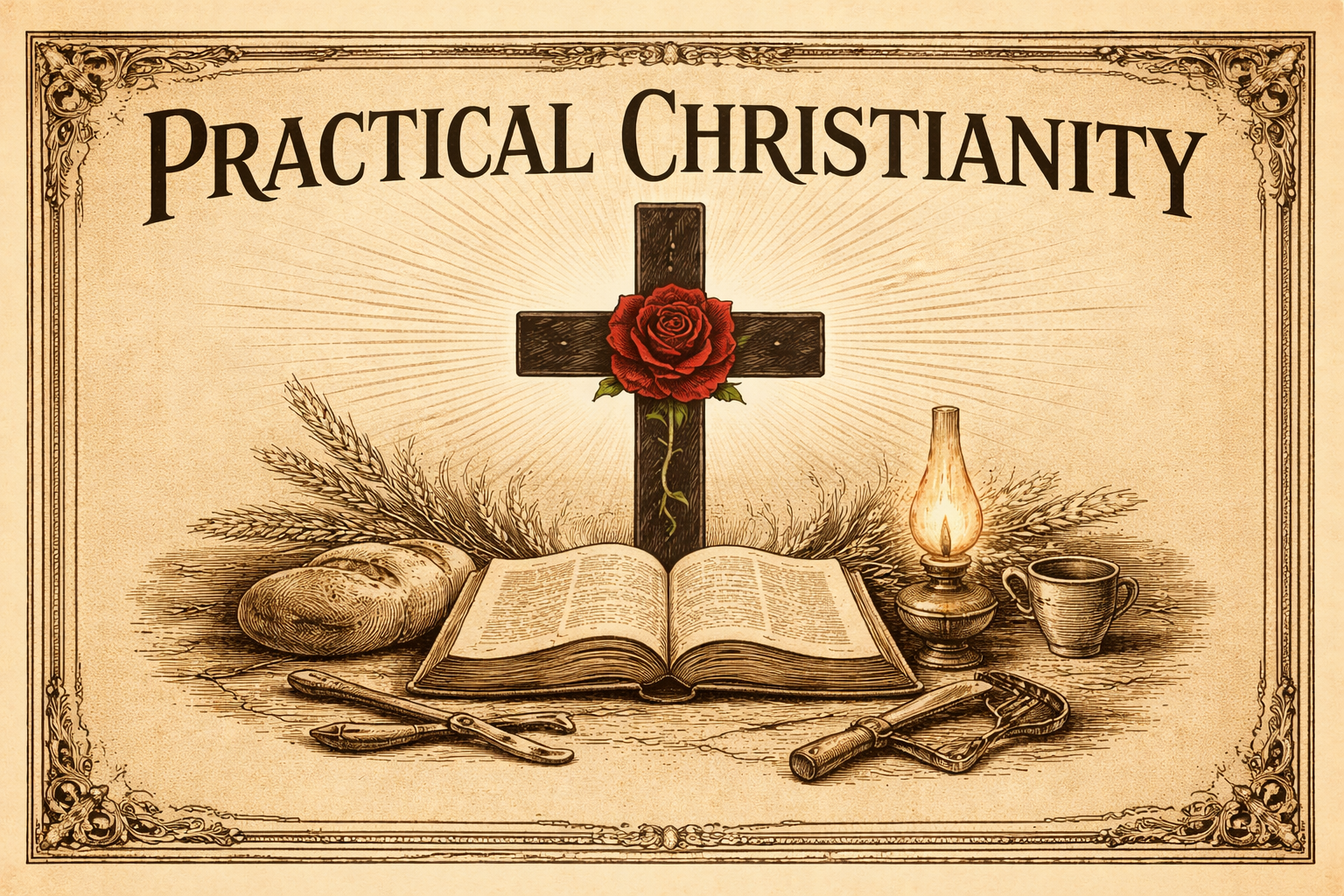
Practical Christianity
Practical Christianity is the application of the teachings of Jesus Christ to the actual ordering of life. It does not consist in profession alone, nor in the repeated use of sacred language while the character remains uncorrected. It requires that a man bring his thoughts, speech, habits, duties, and dealings into obedience to what is right. For religion is not proved by what one says of Christ, but by what one does with what Christ taught. The true question is not merely whether one believes, but whether one is becoming more truthful, more disciplined, more just, more charitable, and more fit to stand before God.
Repentance, therefore, must be understood in its proper sense. It is not passing regret, nor emotion that leaves the old disorder untouched. Neither is it merely the stopping of a wrong. To repent is to turn away from what is false, disordered, and degrading; but it is also to transmute it into its proper form under objective moral order. If a thought is evil, it must not only be refused, but replaced by what is true. If a habit is corrupting the life, it must not only be broken, but converted into disciplined conduct. If desire is disordered, it must be brought under rule and directed toward its rightful end. If conduct is false, it must be amended into uprightness. If wrong has been done, it must be righted. Thus repentance is not mere negation, but re-formation. It is the movement of the soul out of error and into right order. Good deeds are the fruit of this change; and where such fruit is absent, the inner work has not yet been done.
For this reason, Practical Christianity does not answer every trouble with mere religious utterance. It asks what must now be corrected. If the tongue is unruled, it must be governed. If pride is active, it must be humbled. If appetite governs where conscience ought to govern, appetite must be restrained and educated. If one has been negligent in duty, duty must be taken up. If injury has been done to another, restitution must be made. If life has fallen into confusion, life must be brought again into order. Prayer is not set aside; it is necessary. Yet prayer must be joined to obedience, otherwise one asks for help while refusing the terms by which help is received. Mercy is required, but not at the expense of truth; righteousness is required, but not in outward show only.
We do not hold that the Cross is to be praised only in word while its law is refused in life. Every soul has its cross: pride to be subdued, anger to be mastered, lust to be denied, selfishness to be put off, falsehood to be cast out, weakness to be disciplined. No one is excused from this labor. No one is made whole by admiration alone. The way of the Cross is the way by which the lower nature is brought under rule and the soul is strengthened through trial, fidelity, and endurance. Thus the teaching of Jesus is not something distant, ceremonial, or merely consoling. It is a rule of life. It is to be enacted in the home, in work, in speech, in conduct, in self-government, and in duty. This is Practical Christianity.
It is here, in these plain and daily fields, that the reality of religion is tested. A man’s Christianity is shown by how he governs himself when provoked, how he speaks when angered, how he labors when no praise is given, how he orders his household, how he fulfills obligation, how he bears suffering, and how he conducts himself toward others in justice, mercy, and truth. The teachings of Jesus Christ are not reserved for the hour of worship alone, but are to be carried into the common life of man and made active there. Practical Christianity, therefore, is not abstraction, nor sentiment, nor pious appearance; it is the continual bringing of the life into conformity with what is eternally right.